

Mobile money has established local payment rails at an enormous scale. As its role expands, the conversation is moving towards how those rails connect, how businesses access them and what it takes to make them work reliably.
Mobile money is approaching 20 years of live deployment in Africa. In that time, it has expanded access to digital financial services and created infrastructure used for person-to-person transfers, remittances, merchant payments and a growing range of financial products.
As mobile money matures, the focus is shifting from access towards utility: where can people use their money, which services can they access and how easily can businesses participate in the ecosystem?
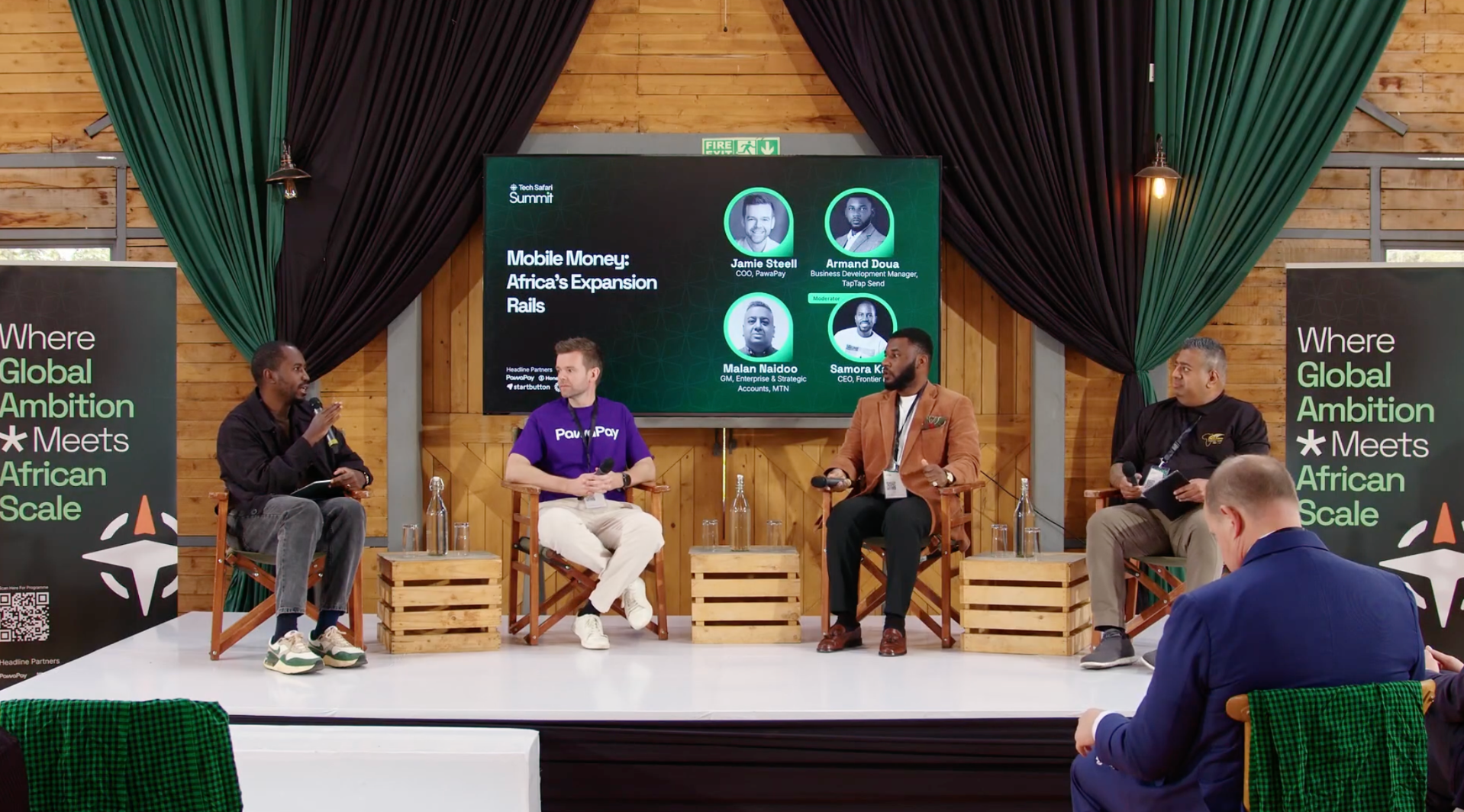
This was the focus of Mobile Money: Africa’s Expansion Rails, a recent Tech Safari panel in Nairobi featuring PawaPay COO Jamie Steell, Malan Naidoo from MTN and Armand Doua from Taptap Send. With Samora Kariuki from Frontier Fintech steering the conversation, they got into merchant payments, interoperability, national payment switches, regulation and cross-border commerce.
For businesses, much of this comes down to one question: how do you reach customers using local payment methods across multiple African markets without building a separate payments operation in each one?
We’ve summarised five of the key themes that came out of the discussion.
Malan described MTN’s view of mobile money as a progression from financial inclusion to financial access and now towards greater participation. That includes increasing merchant payment acceptance and expanding the financial services available through mobile money.
Taptap Send is seeing this from a different part of the market. Armand spoke about moving beyond the original remittance use case into areas such as SME payments, trade and investment.
The more customers can do with the money in their wallet, the more useful mobile money becomes. If they can pay more merchants directly, there are fewer reasons to cash out before they can spend.
Kenya shows how far this can go. M-PESA is part of everyday commerce, not simply a way to send and receive money. Other markets won’t develop in exactly the same way, but the direction is similar: more ways to use digital money across the economy.
For businesses selling into these markets, that means being able to accept the local payment methods customers already use.
There is no single African payments system. Each market has its own mix of mobile money operators, banks, national payment switches and regulation. The differences don’t stop at the API.
PawaPay operates across 23 African markets, dealing with differences in transaction processing, reconciliation, fees, error codes, settlement and operational support. Jamie used Tanzania as an example on the panel. Several mobile money operators serve the market, each with its own infrastructure and operating requirements. Connecting to one doesn’t automatically connect you to the others.
Looking at this from a merchant lens, Jamie commented: “If I’m Google or Netflix, I just want to take payments and for it to work.”
A merchant entering Tanzania doesn’t want to become an expert in how every local mobile money operator works. The same applies when that merchant moves into its second, fifth or tenth African market.
It’s not about making the underlying systems identical. It’s about giving businesses a practical way to access them.
Malan explained that MTN has standardised its technology across its footprint, including its mobile money platform and integration stack across 14 markets. This gives businesses connecting to MTN a more consistent technical starting point across those markets.
National payment switches are tackling another part of the problem by connecting financial institutions and payment systems within individual countries. The panel discussed NIBSS in Nigeria, GhIPSS in Ghana and Zambia’s National Financial Switch as examples.
Then there’s interoperability between wallets and networks.
Armand described what that could eventually look like for a customer: “I have a dream that with my mobile money from Côte d’Ivoire, when I come to Kenya, I can get my wallet back home debited to pay a merchant here, even on his M-PESA.”
Instead of cashing out, exchanging money and starting again on another payment system, the customer could continue using the wallet they already have.
For merchants, better connections between payment systems mean reaching more customers without creating a new payment experience for every network or market.
A common API can simplify the technical connection, but regulation is still local. Settlement arrangements differ. Banks, switches and mobile money operators have their own requirements. Cross-border transactions bring foreign exchange, licensing and regulatory reporting into the picture.
Jamie discussed regulatory passporting between Ghana and Rwanda during the panel. PawaPay already held licences in both countries and wasn’t part of the pilot, but its conversations with regulators raised some practical questions. Who is accountable when something goes wrong? Where are regulatory returns filed? How do different local requirements apply?
The same principle applies at transaction level. A merchant needs to know whether a payment succeeded. Funds need to reconcile and settle correctly. If something fails, the information coming back needs to explain what happened well enough for someone to act on it.
It also needs to happen fast. Customers cannot be left standing at a till wondering whether their payment worked, or even worse “where is my money?”.
At merchant scale, unclear payment statuses mean customer service cases, reconciliation work and manual investigation. Connectivity matters, but so does what happens after the connection is made.
When Jamie was asked how PawaPay manages operations across 23 markets, he focused on people and relationships as much as technology.
PawaPay made an early decision that operating mobile money infrastructure at scale meant working closely with the operators running the underlying rails. Jamie referenced PawaPay’s relationships with MTN, Airtel, Orange and Vodacom, as well as the work local teams do with regulators.
Those relationships matter when an operator connection has an issue, regulation changes or a settlement process needs attention. A merchant expanding across Africa shouldn’t have to build those capabilities market by market.
The same applies to regulation. PawaPay’s approach is to engage regulators on current operations and future plans rather than treating regulatory approval as something to deal with at the end of a launch.
For merchants, most of this should be invisible. They need the payment method to work. The infrastructure provider needs to understand what is required locally to make that happen.
One of the positives from the panel was just how much progress is already happening across mobile money infrastructure. Operators are standardising technology. National switches are connecting domestic payment systems. Interoperability is opening up new possibilities for how wallets can be used.
But businesses will still encounter different currencies, operators, regulation and settlement arrangements as they expand across Africa. They shouldn’t have to solve those differences one market at a time.
PawaPay was built around that problem. Businesses connect through one API, while PawaPay manages the local integrations and the regulatory, treasury, settlement, reconciliation and operational work behind them.
For the merchant, the ambition remains the one Jamie described on stage: take payments and have them work.
Mobile Money: Africa’s Expansion Rails took place at Tech Safari in Nairobi, bringing together Jamie Steell, COO at PawaPay; Malan Naidoo from MTN; and Armand Doua from Taptap Send, with Samora Kariuki from Frontier Fintech moderating the discussion.

.png)